
The report most families never read
Shocking Congressional Report: A Year-Long Blackout Could Kill Up to 9 in 10 Americans. Your Tap Water Is One of the First Things to Go.
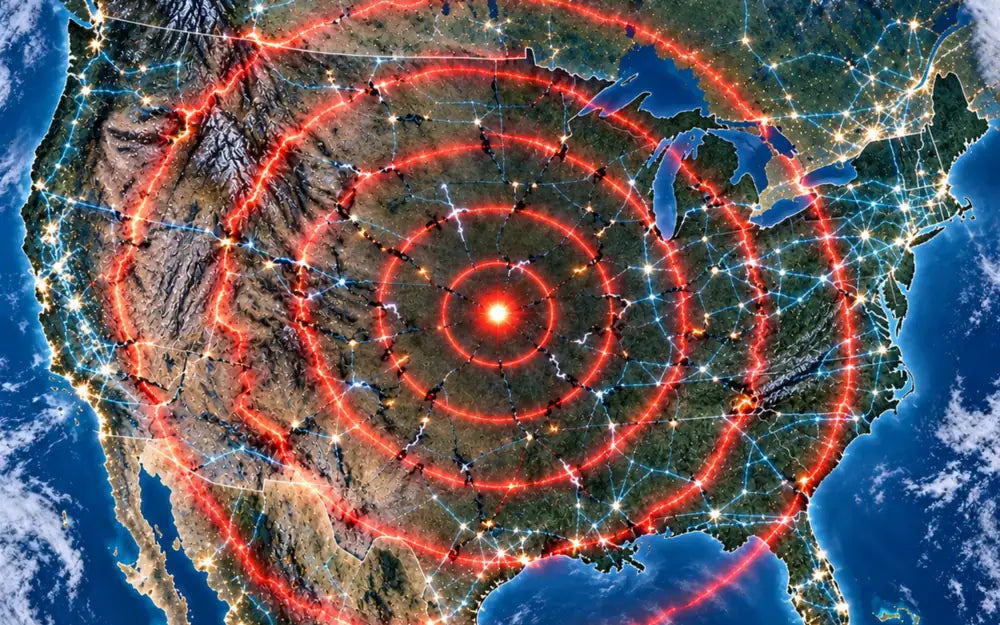
That’s the EMP Commission’s estimate for its worst case. But you don’t need the worst case to lose your water. In 2024, one storm left Asheville, North Carolina without safe tap water for 53 days.
Most people think the danger in a long blackout is the dark.
It isn’t.
Congress created the EMP Commission to study what an attack on America’s power grid would do to the country.
Not the darkness. What goes down with the grid.
And one of the first things to go is the water in your kitchen tap.
The commission’s former chief of staff went further. He told a House committee that a major EMP event “would immediately deprive most of the U.S. national population of running water.”
That’s the worst case. You may never live through it.
But you don’t need an attack, or a year, to lose your water. In 2024, it took one storm. In 2021, it took a cold snap.
And this year, a war is squeezing the diesel that keeps water plants running when the power goes out.
Hurricane Helene · Western North Carolina, 2024 One storm. 53 days without safe tap water.
On September 27, 2024, Hurricane Helene’s floodwaters ripped out the big water mains at the plant that supplies about 80% of Asheville, North Carolina and the county around it. The backup lines went with them.
Faucets across the region sputtered and went dry.

53 days. Could your family make it?
What Asheville lived through, as reported at the time.
-
Day 1
The taps go dry.
Whatever water is in the house is all you have.
-
Week 1
“No timeline.”
Officials can’t say when the water will come back. Families line up at a tanker truck with milk jugs and buckets, and haul pool water just to flush.
-
Week 3
The water’s back. You still can’t drink it.
It flows to most of the city again, but the reservoir is still too muddy to treat.
-
Day 53
Safe to drink again.
Nearly two months after the storm, the boil-water notice finally lifts.
Sources: ENR, the Associated Press, North Carolina Health News, the Asheville Citizen-Times and Blue Ridge Public Radio.
The cruel part: those mountains are full of water. Rivers, creeks, springs, rain barrels on back porches. But untreated water can carry giardia, a parasite the CDC says makes more than a million Americans sick every year.
The water families had stored got them through the first few days. It couldn’t get them through 53.
Texas · February 2021 It doesn’t take a hurricane. In Texas, it took a cold snap.
It isn’t just weather Blackouts. Hackers. War. Your tap can fail a lot of ways.
You can’t stop any of that. You can decide whether your family has a way to make drinking water when it happens.
Do the math Your stored water is a countdown.
Maybe you have cases of water in the garage. Good. Keep them.
But every bottle you open is one you can’t get back.
The CDC says to store at least one gallon per person, per day. For a family of four, that’s 12 gallons to get through three days. About 100 pounds of water.
Watch how fast it goes. Day one, you’re fine. Day two, you start rationing. Day three, you open the last jug.
Day four, you’re out. Asheville went 53.
12 gallons. 4 people. 3 days.
Illustration at 1 gallon per person, per day. Your household may need more.
What would have changed everything Not more bottles. A way to make your own.
Nobody stores 1,770 pounds of water. Nobody has room for it.
So picture those 53 days with one difference.
Instead of waiting in line at a tanker truck, you fill a bag from the rain barrel behind your house. You hang it from a hook on the porch and walk away. When you come back, your pot is full of filtered water.
No power. No pumping. No line.
The backup that makes its own water Meet the Fortisk Gravity Water Kit.

It’s a family-size water filter that runs on gravity, not electricity.
Fill the 1‑gallon bag from a rain barrel, creek, pond or lake and hang it up. Gravity pulls the water through a hollow-fiber filter that strains out bacteria and parasites like giardia, and clean water runs into your pot or jug while your hands are free.
Stored water only counts down. This makes more, gallon after gallon. And when the grid goes down, it keeps working, because gravity doesn’t need the power company.
It packs flat, so you can keep one at home and one in the car.
How it works
-

Fill the bag
Scoop water from a rain barrel, creek, pond or lake.
-

Hang it up
From a hook, a branch or a door frame.
-

Open the valve
Filtered water runs into your pot or jug, hands-free.


90-day money-back guarantee
How the usual backups compare
| Feature | Bottled water | Boiling | Filter straw | Gravity kit |
|---|---|---|---|---|
| Works with no power or fuel | Yes | No | Yes | Yes |
| Makes more water once your stored water runs out | No | Yes | Yes | Yes |
| Fills pots and jugs for the household | Partly | Yes | No | Yes |
| Small enough for a car kit | Partly | Partly | Yes | Yes |
Before you buy any filter Look-alikes are everywhere. Here’s how to spot one you can trust.
Search any big online marketplace for a gravity water filter and you’ll find dozens of kits that look just like this one. Some cost half as much. Some of them are fine. Some aren’t. And from a product photo, you can’t tell which is which.
A flashlight that doesn’t work is obvious. A filter that doesn’t work looks exactly like one that does, until someone gets sick.
And fakes are real. Sawyer, one of the best-known names in hollow-fiber filters, warns that counterfeit Sawyer Mini filters have been sold by third-party sellers on online marketplaces. When the appliance industry tested counterfeit refrigerator water filters, 7 of 8 failed to remove 90% of parasite cysts, even though their labels said they would.
So don’t trust any filter on looks or price alone. Ours included. Check for these five things first.

Simple enough for anyone in the house. Each gallon you pour in weighs about 8 pounds, roughly a gallon of milk. Fill it partway if you’d rather lift less. It still works.
Practice once with tap water. Show everyone in the house how it works. Then pack it where you can find it in the dark.
The first time you use it shouldn’t be the day you need it.
Recommended
One for the house. One for the car.
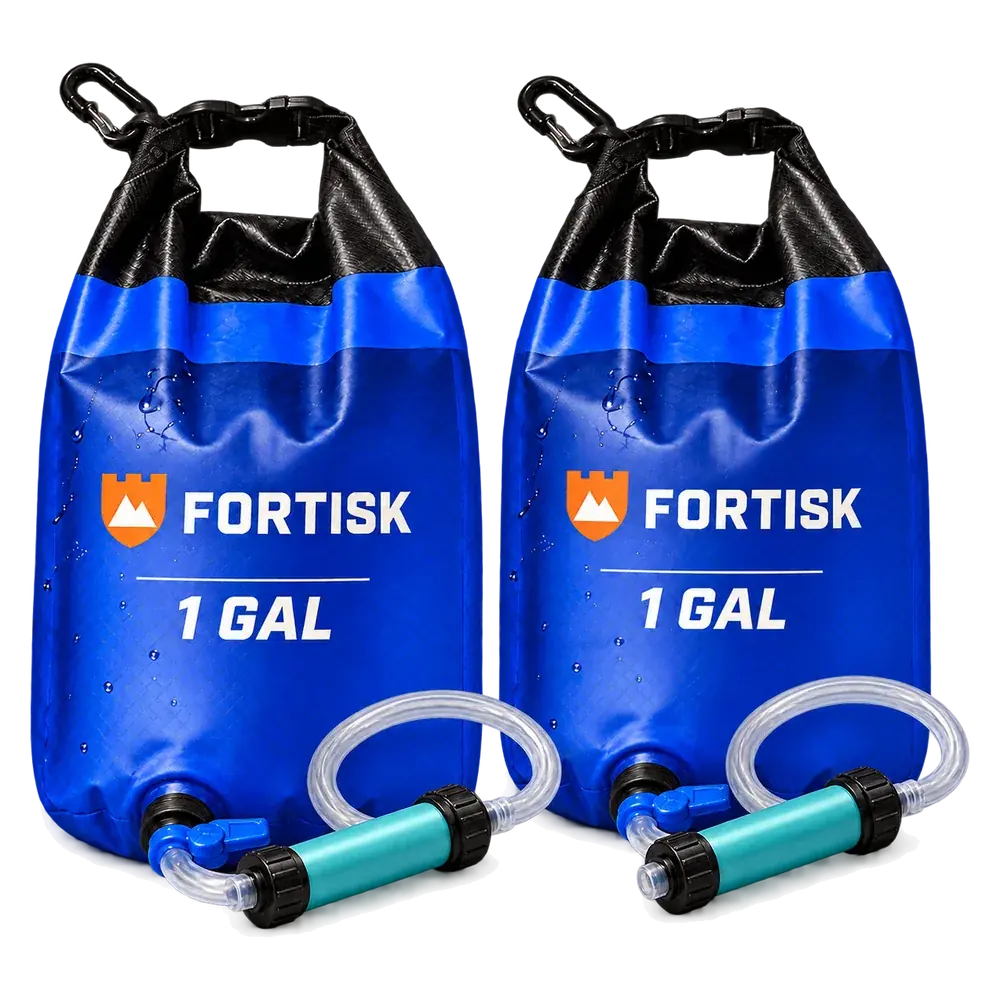
Fortisk Water Survival Kit · 2 Kits
- Works with no power, batteries or pumping
- Filters fresh water from rain barrels, creeks, ponds and lakes
- Fills pots, jugs and bottles for the whole family
- Up to [1,500] gallons per filter, about [4¢] a gallon
$129.95 for 2 kits
Crossed-out price is what one kit costs on its own
Get 2 kits- 90-day money-back guarantee
- Free shipping
Before you decide Questions people ask before they buy.
Why not just buy a cheap filter straw?
Keep your straw for the car. Most straws serve one person drinking straight from the source. The gravity kit fills pots, jugs and bottles for the whole household, hands-free.
Why not just boil water?
Boiling is the safest way to treat water, according to Ready.gov. But it takes fuel and a working stove for every pot, and it doesn’t take out dirt or grit. When you can, filter first and then boil. During a boil-water notice, always boil.
How long does a filter last?
Each filter is rated for up to [1,500] gallons, depending on how dirty the source is and how often you backflush it with the included syringe. Letting muddy water settle first helps it last. Spare filters come in a 2-pack for $29.95.
Do I have to buy two?
No. You can choose 1, 2, 3 or 4 kits on the next page. We suggest two, so there’s one at home and one in the car. Bigger bundles cost less per kit.
Did the EMP Commission or any agency recommend this kit?
No. The reports, testimony and photos on this page are there for the facts about the grid and your water. No agency tested, recommended or endorsed this or any product.
The tap works today. Get your water handled now.
On September 26, 2024, the taps in Asheville worked just fine. The next day they went dry, and the water wouldn’t be safe to drink again for 53 days.
Right now, your tap works. That’s exactly why now is the time. When your kit arrives, fill the bag once with tap water, hang it in the garage and watch it run. Then put it where you can find it in the dark.
So the next time the faucet coughs, and someone you love asks what you’ll do for water, you’ll have a real answer:
“I know where it is. I’ll get it.”
90-day money-back guarantee · Skip the cheap look-alikes
P.S. Do this tonight: count the gallons of water in your house and divide by the number of people. That’s how many days you have. Asheville needed 53.
P.P.S. Keep your stored water. The kit doesn’t replace it. It’s how you keep going after it runs out.
Sources and notes
- Peter Vincent Pry, “Nuclear EMP Attack Scenarios and Combined-Arms Cyber Warfare,” Commission to Assess the Threat to the United States from Electromagnetic Pulse (EMP) Attack, July 2017. The “up to 90 percent” estimate is for an EMP attack causing a nationwide blackout lasting one year.
- Testimony of Dr. Peter Vincent Pry, House Homeland Security Subcommittee on Cybersecurity, Infrastructure Protection and Security Technologies, May 8, 2014.
- ENR, “Repairs to Water Infrastructure Underway After Hurricane Helene” (October 3, 2024).
- Associated Press, “A week after Helene cut water supplies, thousands in North Carolina struggle to find enough” (October 4, 2024).
- North Carolina Health News, “In Helene-ravaged Buncombe, even ‘gray water’ is tough to find” (October 5, 2024).
- Asheville Citizen-Times, on non-potable water returning to about 95% of Asheville’s system (October 18, 2024).
- Blue Ridge Public Radio, “Asheville taps are clear to drink; boil water notice lifted” (November 18, 2024).
- U.S. Army Corps of Engineers, “USACE enhances water treatment for Asheville amid Hurricane Helene recovery efforts” (January 16, 2025): the reservoir and plant supply about 80% of Asheville and Buncombe County residents.
- Photo and caption: Air National Guard (September 30, 2024), via DVIDS. A U.S. government photo in the public domain.
- CBS News, “Blackout Blues In Midwest” (August 2003): Cleveland water service during the 2003 blackout.
- Tomko et al., “Disparities in disruptions to public drinking water services in Texas communities during Winter Storm Uri 2021,” PLOS Water, 2023: over 17 million people under boil-water advisories; advisories averaged about 8 days and some lasted more than a month.
- ABC News, “Texas city forced to shut off water due to winter storm” (February 16, 2021): Abilene.
- TIME, “What to Know About the U.S. Water Systems Cyberattacks” (August 2, 2026), and CBS News, “U.S. investigating if Iran was behind cyberattack on water systems in 7 states, including Minnesota and Michigan” (August 1, 2026): more than 30 Minnesota systems hit; operators switched to manual; officials said the water stayed safe.
- Associated Press via PBS NewsHour, “Majority of Kyiv residents without water after barrage of Russian strikes” (October 31, 2022).
- Encyclopedia of Milwaukee, University of Wisconsin–Milwaukee, “Cryptosporidium” (the 1993 outbreak).
- Al Jazeera, “Is Iran losing its leverage over the Strait of Hormuz?” (September 30, 2026): about 120 to 140 ships a day crossed the strait before the war; at the height of the fighting, as few as two tankers a day.
- USAFacts, “Diesel prices rose 89% from January low to September record high” (September 2026), citing U.S. Energy Information Administration data: $6.53 a gallon on September 21, 2026; crude prices rose with the U.S. conflict with Iran and the blockade in the Strait of Hormuz.
- EPA, Power Resilience Guide for Water and Wastewater Utilities (March 2023): diesel generators are the most common kind.
- CDC: How to Create an Emergency Water Supply.
- CDC: About Giardia.
- CDC: Drinking Water Advisories.
- CDC: How to Make Water Safe in an Emergency. Portable filters need pores of 0.3 micron or smaller (absolute) to remove bacteria and 1 micron or smaller to remove parasites such as Giardia.
- Ready.gov: Water.
- Sawyer Products, “Counterfeit Sawyer Products” (sawyer.com): counterfeit Sawyer Mini filters sold by third-party sellers on online marketplaces.
- Association of Home Appliance Manufacturers, “The Hidden Dangers of Counterfeit Water Filters” (June 29, 2018): testing of counterfeit refrigerator water filters.
- EPA: report to Congress on boil water advisories (2024). 3,221 advisories in 2021 were due to main breaks, repairs and loss of pressure.
Water math uses the CDC minimum of one gallon per person, per day, and about 8.3 pounds per gallon. None of the agencies, companies, reports, news outlets or photographers above tested, recommended or endorsed this product.